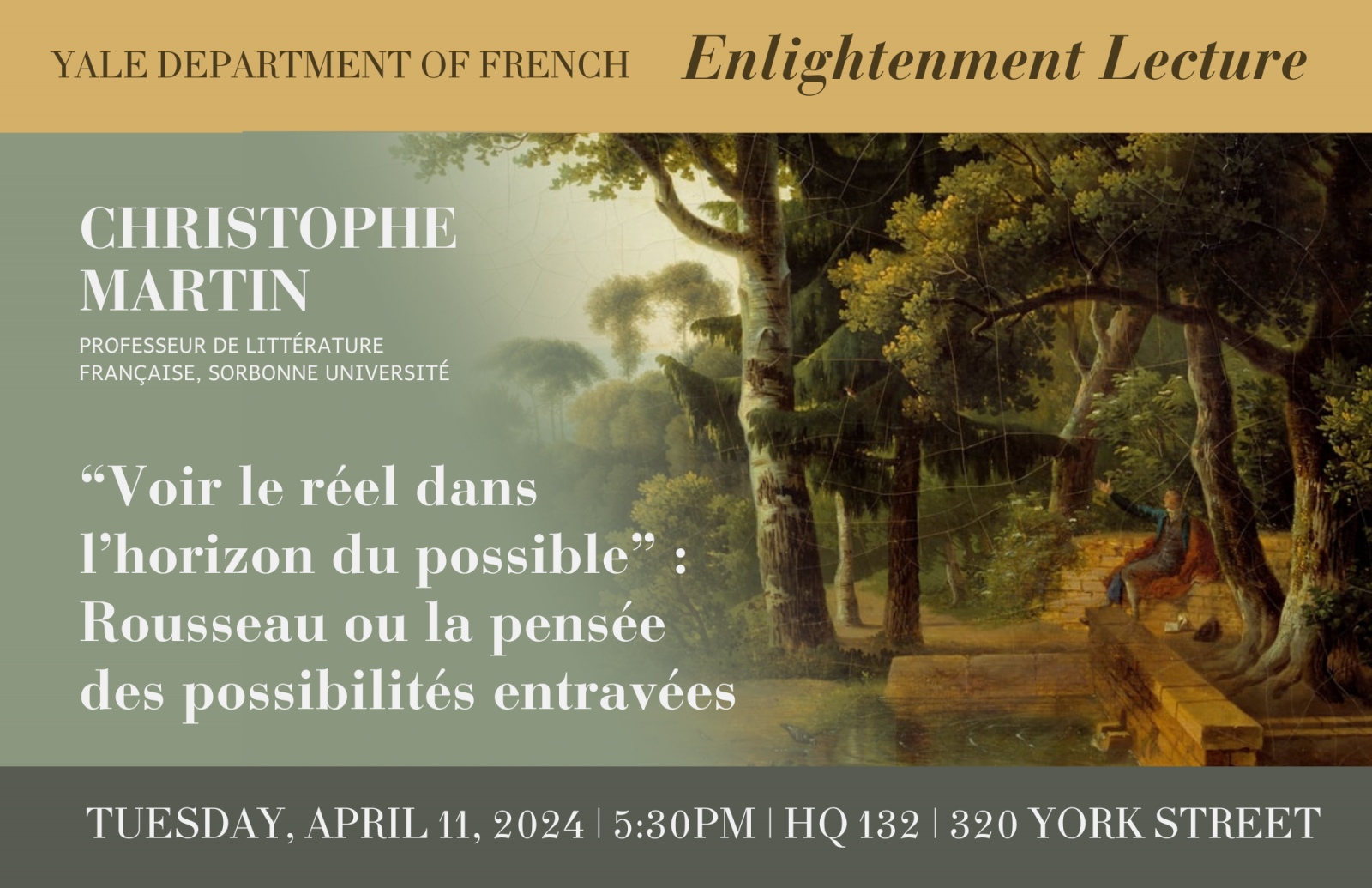
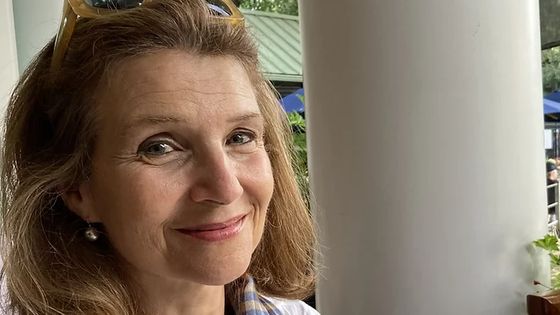
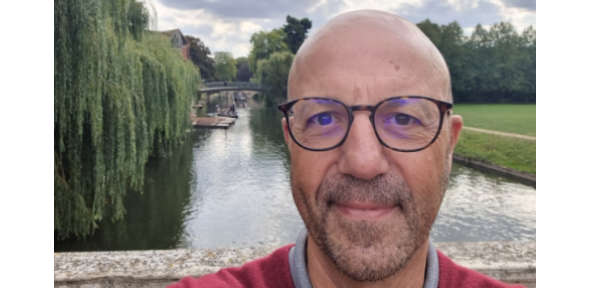
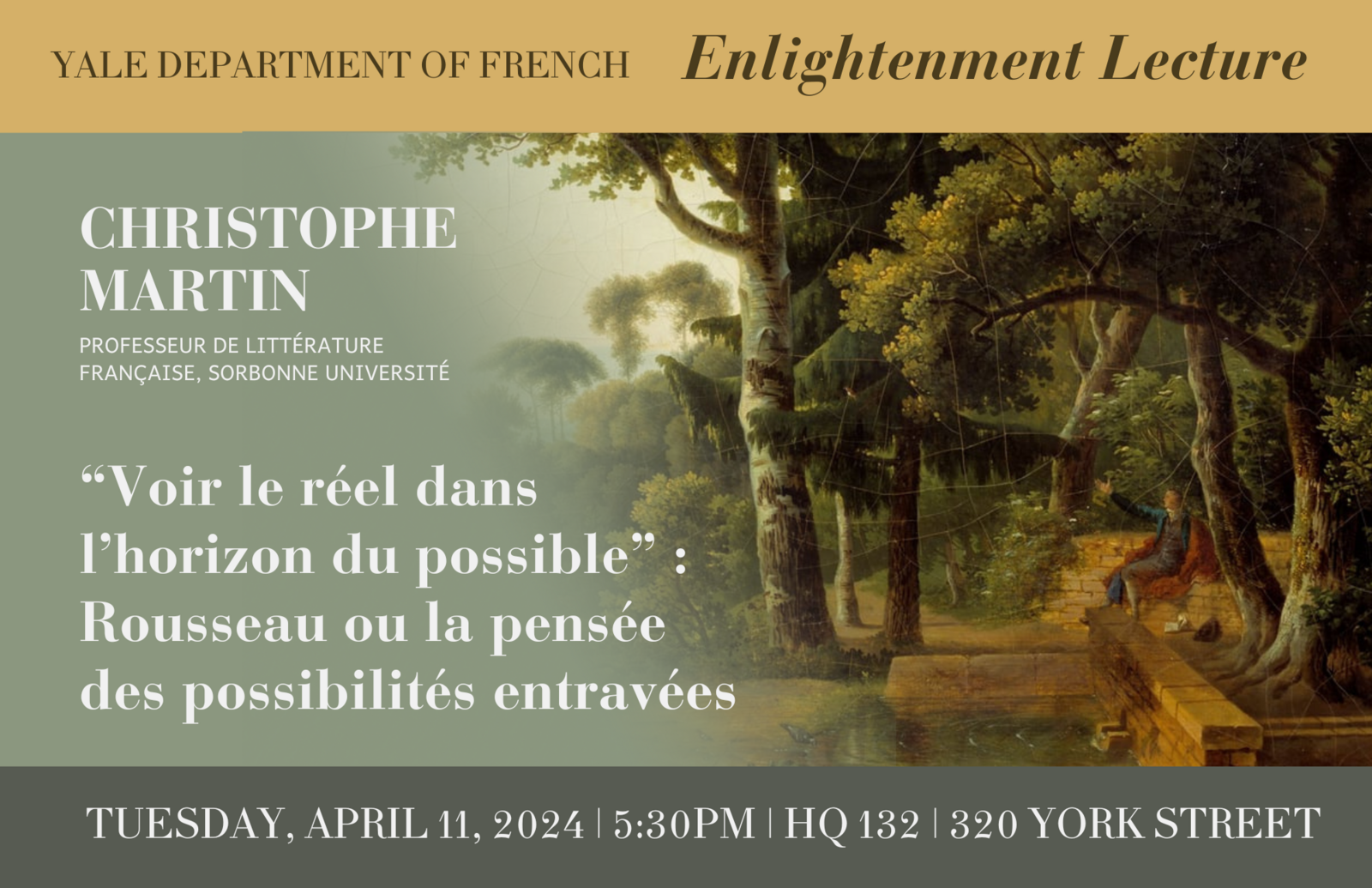
Enlightenment Lecture by Professor Christophe Martin (Sorbonne)
Professor Christophe Martin’s Enlightenment Lecture

Professor Christophe Martin’s Enlightenment Lecture

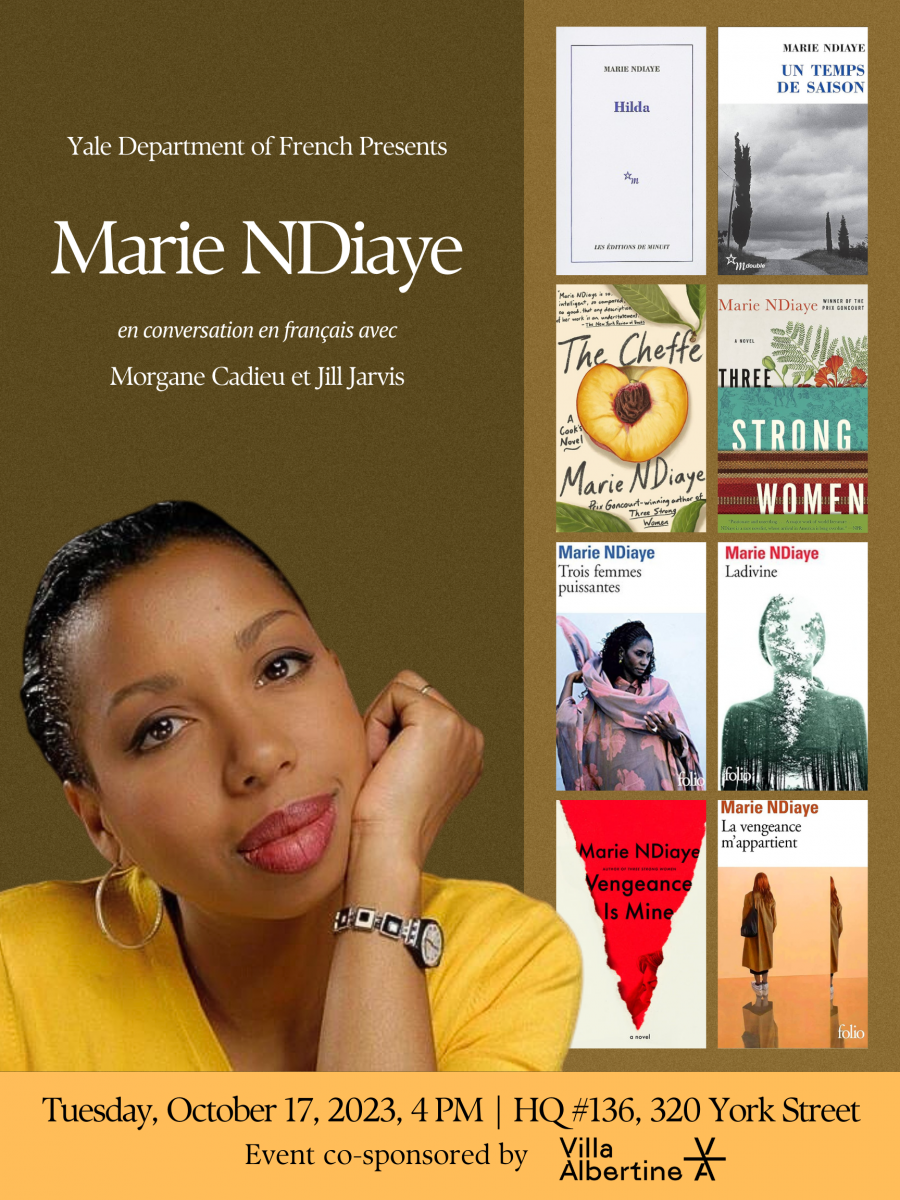
Over a literary career that spans almost 40 years, French novelist, playwright and scenarist Marie NDiaye has carved herself a unique position amid the landscape of French literature. Her work has received France’s highest literary distinctions, her novel, Rosie Carpe won the Prix Femina in 2001, Trois Femmes Puissantes (Three Powerful Women, Knopf) was awarded le Prix Goncourt in 2009, and her play, Papa doit Manger (2003) has been included in the repertoire of the Comédie Française, France’s most prestigious theater company. As a scenarist, she has worked on two internationally acclaimed and multi-awards winning films: White Material (Claire Denis, 2009) and Saint Omer, (Alice Diop, 2022).
All these distinctions seem to have bear no influence whatsoever in her work. Novels after novels, NDiaye’s admirably sinuous sentences track down the unfathomable darkness at the heart of her characters. Her meticulously crafted prose stick as close as possible to her protagonists’ strength, violence, cruelty, or even monstrosity, without revealing anything of their mystery. Dedicated to the aesthetics, musicality and psychology of her characters, she states: “I look for the music in a sentence; the subtextual harmony emanating from a book of imagination that makes us feel that it could not have been written any other way.” She defines herself as a novelist of “ambiguity” and literary critic Hugo Pradelle describes her as a “novelist of unique discomfort.”
The heroine of Vengeance is Mine is Maître Susane, a quiet middle-aged lawyer living a modest existence in Bordeaux, known to all as a consummate and unflappable professional. But when Gilles Principaux shows up at her office asking her to defend his wife, who is accused of a horrific crime, Maître Susane begins to crack. She seems to remember having been alone with him in her youth for a significant event, one her mind obsesses over but can’t quite reconstruct. Who is this Gilles Principaux? And why would he come to her, a run-of-the-mill lawyer, for such an important trial? Vengeance Is Mine is a dreamlike portrait of a woman afflicted by failing memories and a tortured uncertainty about her own past that threatens to become her undoing.
MARIE NDIAYE is a writer, a novelist, a playwright, and a screenwriter. After studying linguistics at La Sorbonne, she was awarded a scholarship from the French Academy to study at Villa Medici in Rome. She is the author of 14 novels, which won a variety of awards, including the Femina Prize in 2001 for Rosie Carpe and the Goncourt Prize in 2009 for Three Strong Women. In 2004, she published All My Friends, a collection of short stories, and three young adult fiction novels, La Diablesse et son enfant, Le Paradis de Prunelle and Le Souhait. For the stage, in addition to Papa doit manger, she also wrote Hilda, Les Serpents, Les Grandes Personnes, Te Craindre en ton absence, Trois Pièces (Honneur à notre élue, Délivrance, Berlin mon garçon), Rien d’humain, Royan, La Professeur de français.
The text above is taken from Villa Albertine, a co-sponsor of the event.
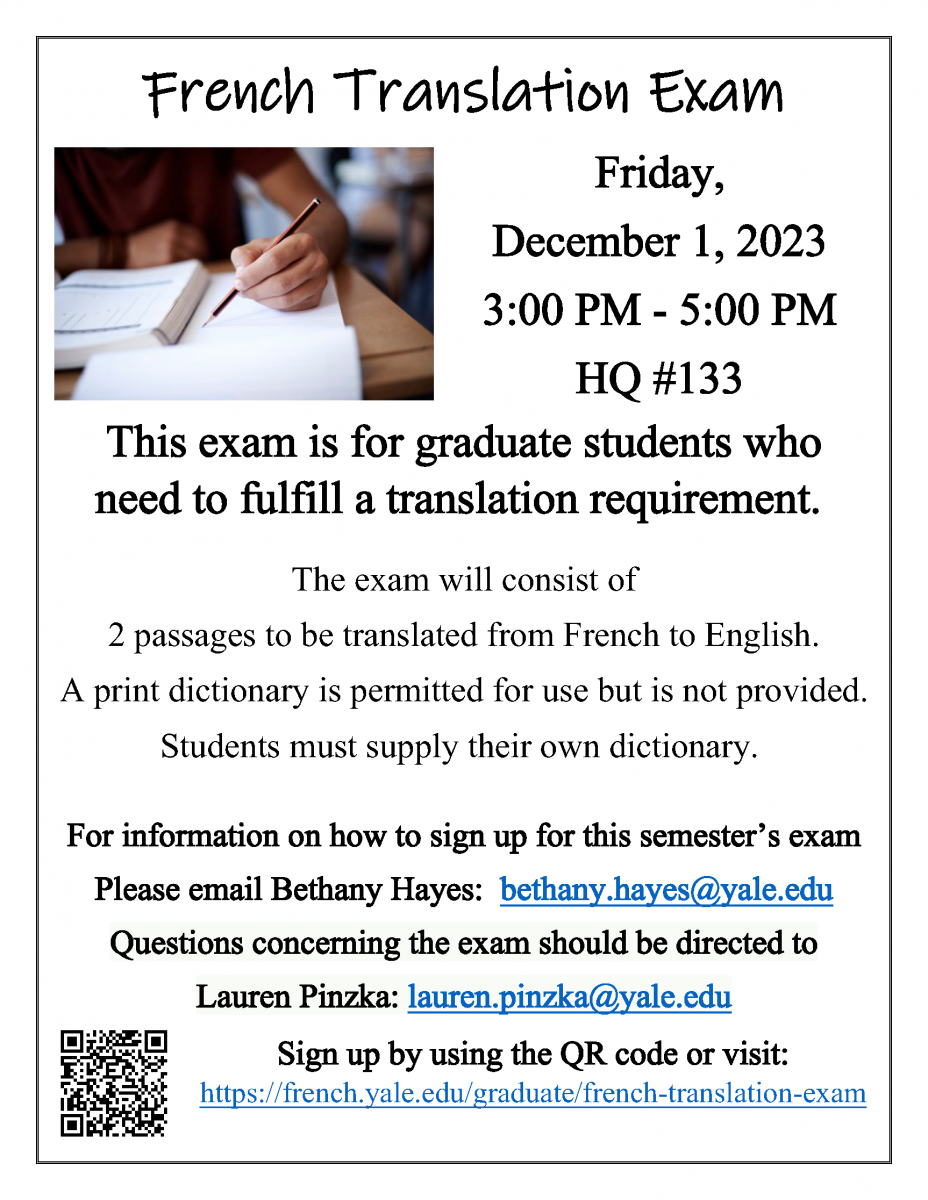
This exam is for graduate students who need to fulfill a language requirement. Exams consist of two passages to be translated from French to English. A print dictionary is permitted for use, but not provided; students must supply their own. Exams are held once per semester.
3:00 - 5:00pm, Friday December 1, 2023 HQ #133
PLEASE USE THIS QUALTRICS SURVEY TO SIGN UP FOR THE EXAM.
Contact Lauren Pinzka, Exam Proctor, for questions concerning the exam.
Please email the French Registrar, Bethany Hayes, if you have questions on how to sign up for the exam.

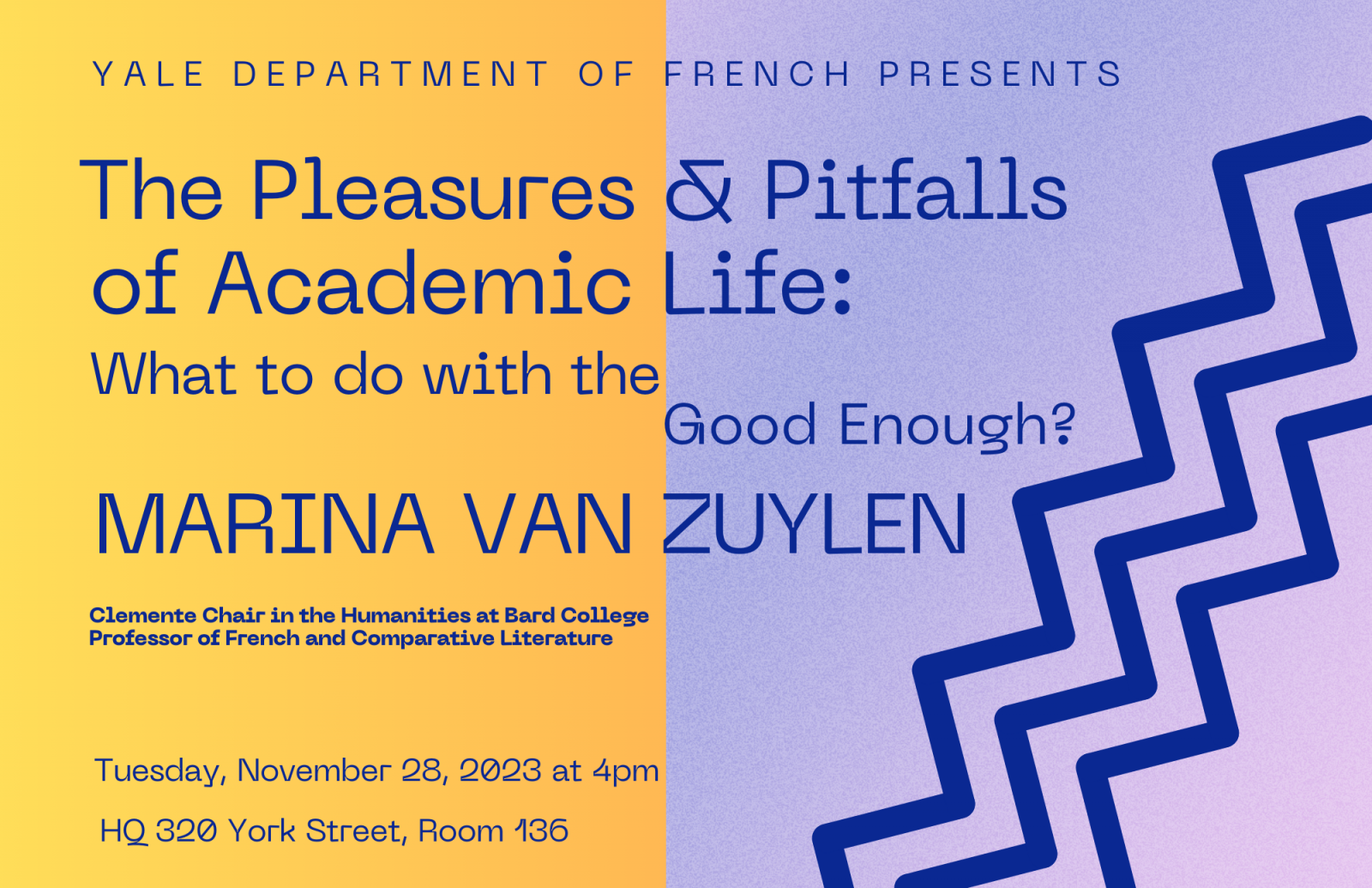
Title: “The Pleasures and Pitfalls of Academic Life: What to do with the Good Enough?”

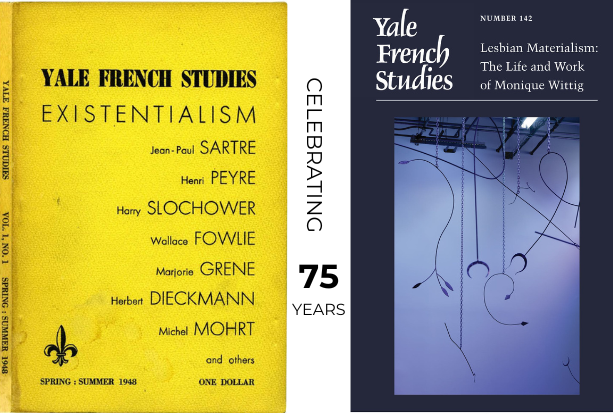
Join the French Department to celebrate the 75th anniversary of Yale French Studies, the country’s oldest English-language journal devoted to French and Francophone literature, language, and culture. To mark the occasion, we offer two dramatic readings in French: An excerpt from Jean-Paul Sartre’s Les Mains sales that appeared in the first volume of Yale French Studies will be paired with a selection of scenes from Monique Wittig’s Le Voyage sans fin to highlight the publication of our next volume # 142, “Lesbian Materialism: The Life and Work of Monique Wittig.” The volume’s editors, Morgane Cadieu (Yale) and Annabel L. Kim (Harvard) will be on hand for this special evening. Reception to follow.
Thursday, November 2nd at 5 p.m. // HQ, Room 134
RSVP here.
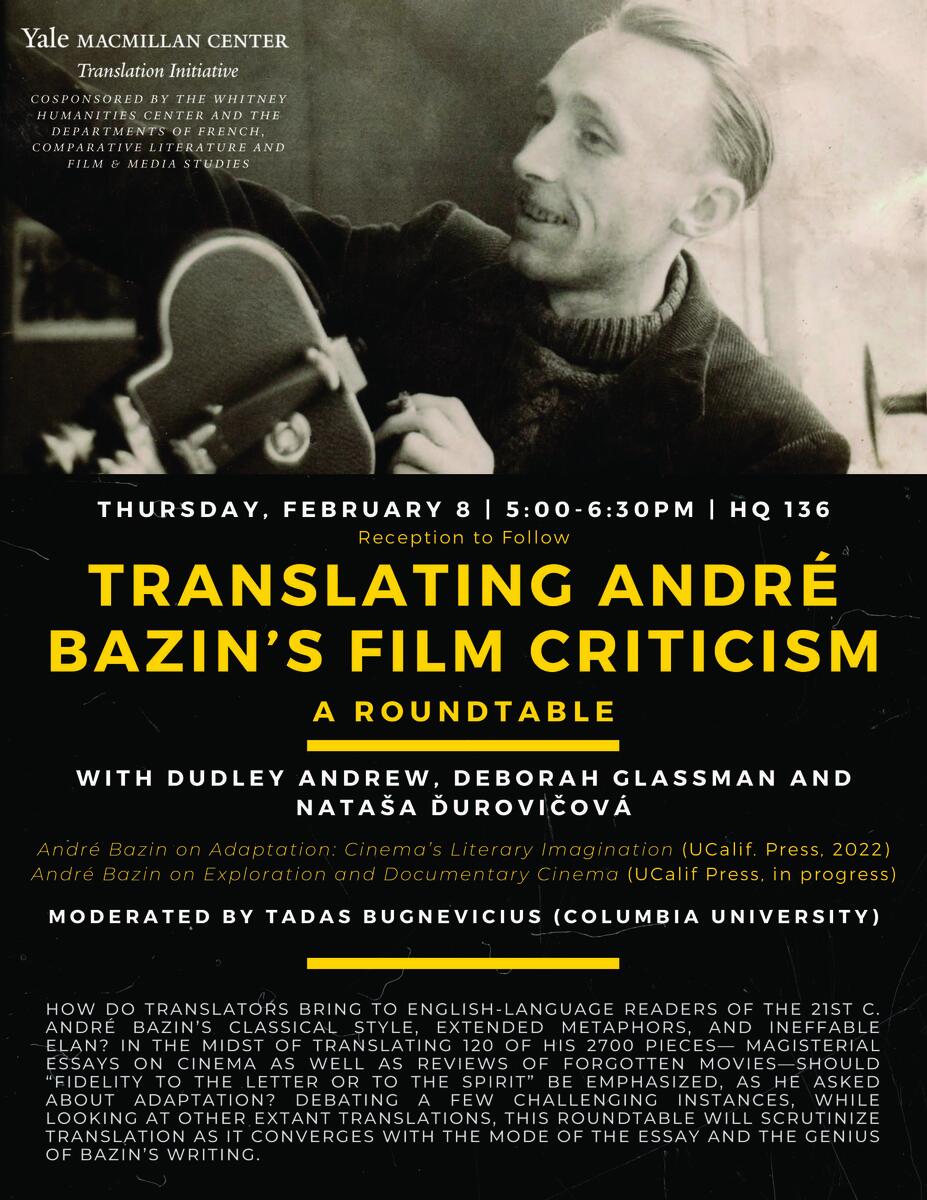
Moderated by Tadas Bugnevicius (Columbia Univ.)
link to the event
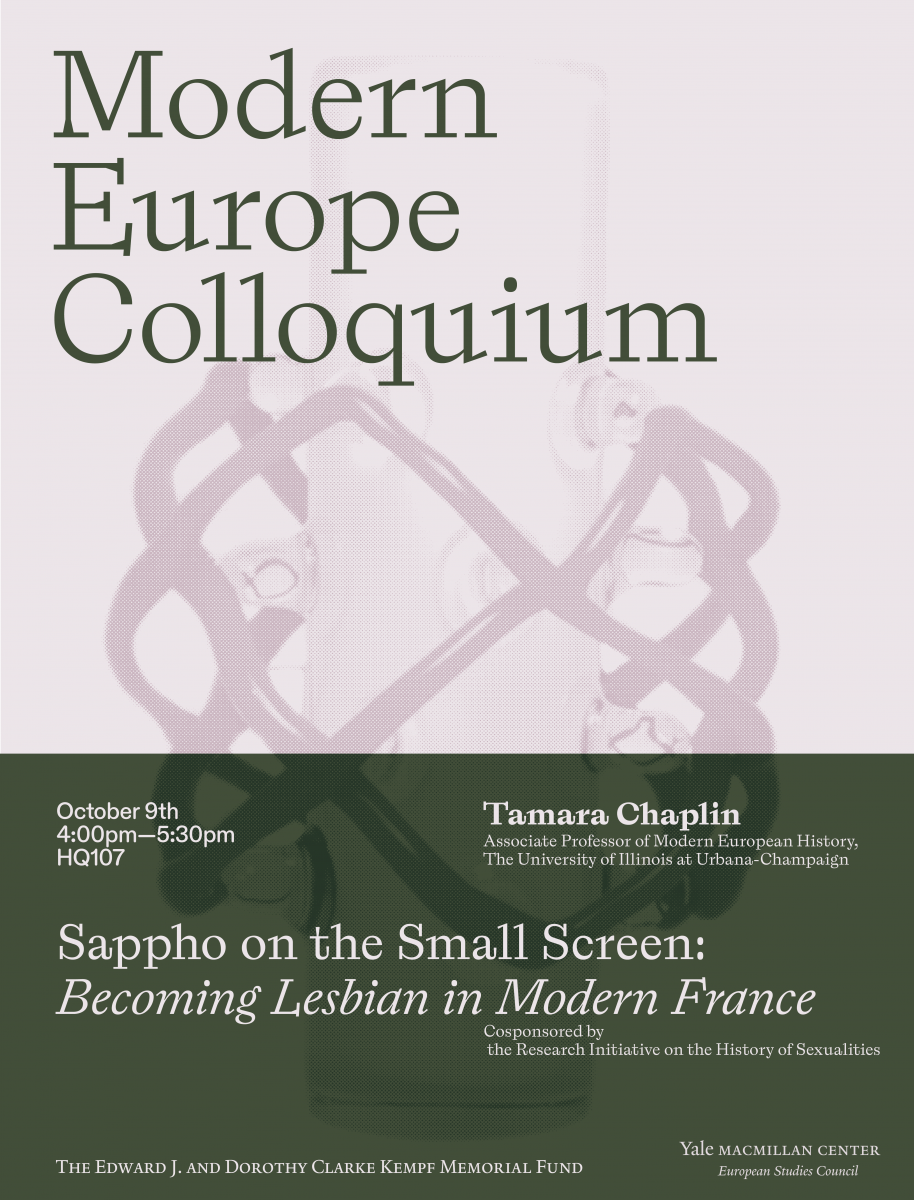
Lecture Title: “Sapho on the Small Screen, Becoming Lesbian in Modern France”
Event co-sponsored by YRIHS and the Modern European Colloquium.
More information about Prof van Zuylen’s lecture coming soon
Lecture Title: Madness and Colonialism in Frantz Fanon’s thought.
Frantz Fanon (1925-1961) is principally known as a theoretician of race relations and decolonization, in particular in the two main books he published during his lifetime: Black Skin, White Masks (1952) and The Wretched of the Earth (1961). What is less known is that he was in parallel a dramatist, a pioneering psychiatrist and an early and recognized theoretician of ethnopsychiatry. With the publication by Jean Khalfa and Robert JC Young of Alienation and Freedom, 800 p of unpublished or presumed lost texts by Frantz Fanon became available (La Découverte, 2015 and 2017, Bloomsbury 2018 and 2020).
These works reveal an astonishing dramatist, an original psychiatrist, and above all the significance of these dimensions of his thought for the understanding of his political texts. This talk will look at these links from two perspectives 1) the nature of the decolonization process when read through Fanon’s theatre and his texts on psychiatric internment, violence, and his pioneering model of social therapy and 2) Fanon’s analysis of “identity” first as a pathology and then as a mystification when presented as a cultural foundation for newly decolonized states, in relation to his systematic questioning of any “constitution” of the self in his psychiatric and ethnopsychiatric theories and practice.
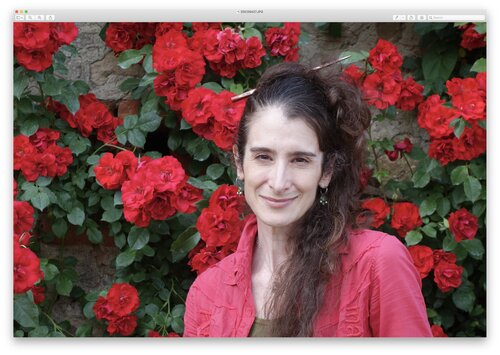
Professor Jean Khalfa is Trinity Professor of French Studies at Trinity College, Cambridge.